Worthwhile work
My intentions for 2026

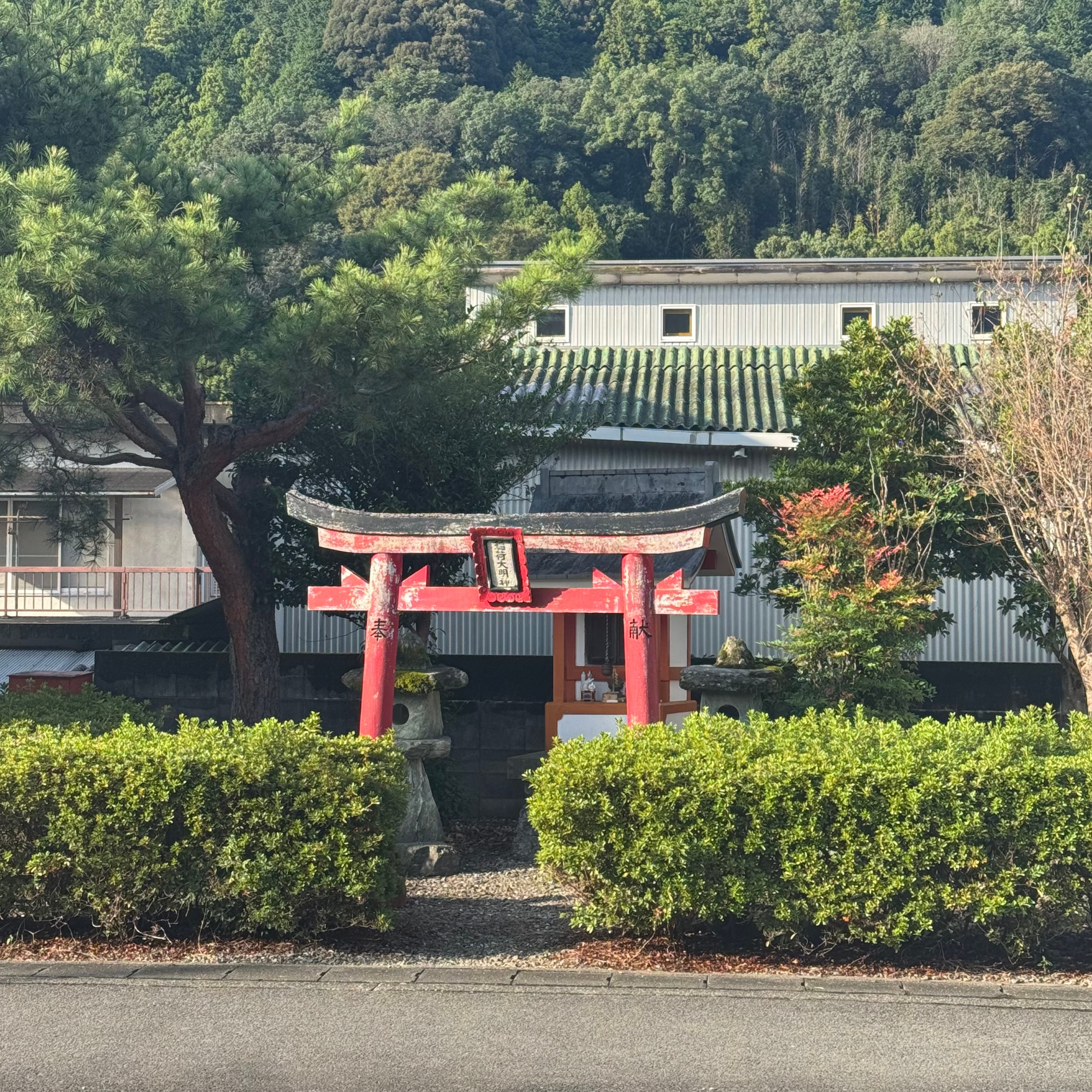
One of my primary motivations for taking a sabbatical was to explore my relationship with work.
In 2025 (and 2024, and definitely part of 2023…), the work I was doing and the way I was doing it resulted in significant burnout. Friends regularly pointed this out to me and gave me advice that usually took the form of one or more of the following:
You need to establish more robust boundaries so that you can have better work-life balance
You need to treat work more as a means to an end (sometimes phrased explicitly as “you need to care less”)
You need to learn how to deal with it because work is always going to suck
None of this is bad advice per se (comment below if you think I just need better friends), but it never particularly resonated with me. No matter how hard I try, I can’t seem to wrap my head around caring less about the thing I spend the majority of my waking hours doing. I also just can’t accept treating it primarily as a means to an end.
This left me in an uncomfortable position. I couldn’t deny that I was burned out primarily because of work, but I also refused to deprioritize it. This seemed unlikely to be a winning strategy.
With the time afforded by unemployment, I’ve been able to untangle these threads a bit. One of the first places I started was with an articulation of my “Workview” from an exercise I did with a group of friends in 2020 when we read Designing Your Life together on Zoom (pandemic bookclub style). The goal of the exercise is to get you to articulate answers to questions like:
Why work?
What’s work for?
What does work mean?
How does it relate to the individual, others, society?
What defines good or worthwhile work?
What does money have to do with it?
What do experience, growth, and fulfillment have to do with it?
Here’s what I wrote then:
We spend a lot of our lives working, so that work better be worthwhile. Worthwhile work is work that creates value for ourselves, our loved ones, and society at large. Work should be the eager application of intellectual rigor and should manifest something that actually moves the needle (i.e., creates value). Moving the needle is not easy, so work will often be challenging and require that we learn new things in order to solve new problems. Succeeding at work (and creating value) will require the dedication and support of a diverse group of people who make a conscious effort every day to all row in the same direction because they have a genuine conviction that what they are doing will create value. Work gives us the opportunity and the medium to create something that we couldn’t create alone and that conventional wisdom may say is impossible.
Value can come in many forms. No form of value is necessarily better than another, but we should strive to create net or holistic value. Creating value for a single beneficiary may indicate that we are merely transferring value from one party to another. Similarly, creating value in a single dimension may indicate that we are merely exchanging one type of value for another. Exchanging one area of value so that we can create a multiple of another may be worthwhile, however. We should frequently evaluate our work to ensure we are engaging in value creation instead of just value arbitrage.
Because it’s so much easier to just exchange value rather than create it, worthwhile work will often involve creating something new or doing something that’s never been done before. With that in mind, we should make sure to critically evaluate all endeavors (and perhaps new endeavors particularly so) to ensure they are actually creating value and not just exchanging it.
Having reread that multiple times over the past few months, and following a significant amount of introspection, I now have a clearer sense of what it was about the work I was doing that caused me to burn out.
It wasn’t the lack of work-life balance or my inability to treat work as a means to an end. It was that, despite the significant benefits afforded to me by various jobs and my career at large, I did not feel that the work I was doing was worthwhile enough for me. This is not a judgement of the work itself. Rather, it’s an evaluation of my compatibility with that work.
To put it simply—to me, the work I was doing was just not worth it.
This insight resonates much more strongly for me than the advice my friends were giving me because, in certain contexts, I have tremendous capacity for work and would actually rather work than not. Historically, I had struggled to define what exactly those contexts were (or would be), but now I at least had a clue that it had something to do with this concept of “worthwhile work”.
So, with 2026 on the horizon, I want to take the opportunity to articulate a more explicit answer to the question—what does it take for me to feel like work is worth doing?
This is not meant to be a judgment against anyone else’s conception of work or job or career. This is an attempt to build clarity for myself, both to better understand why previous work I was doing resulted in me feeling discontented and to set my intentions for the future.
What worthwhile work means to me
Before I start, I want to acknowledge that my perspective comes from a place of privilege. I have the luxury of being able to choose the type of work I do (and, at least for a time, to choose to do none at all). Most people do not have that privilege. Because I do, I believe it’s my responsibility to choose well, which is why I am trying to be so intentional about the sort of work that I do.
So, with that being said, I need at least three things to be true in order to feel that the work I’m doing is worthwhile. I also need the people I’m working alongside to generally agree with these principles.
1. Net value is being created
I need to work on something where the sum of my labor (and that of everyone else I’m working with) is greater than its parts. That value can come in many forms: financial returns, new capabilities, reduced friction, pure enjoyment, improvements in people’s lives, knowledge that advances the field. The key question is—are we making the pie bigger? Or are we just redistributing an existing (or even worse, a shrinking) pie? How do we know?
A lot of businesses seem to be designed to efficiently extract value rather than to create it. I have worked for multiple companies that provided genuine value to customers, but behind the scenes, delivering that value to customers necessitated that staff be constantly on call, work way beyond normal hours, and put in an extreme amount of effort that was justified by versions of “this is just what it takes” or “this is just what our customers expect.”
In my opinion, organizations that operate in this way aren’t creating net value. They’re extracting value from employees (who believe they are part of something meaningful and/or don’t have better alternative job opportunities) in order to transfer that value to customers. Of course these employees are getting paid, but not in a way that is commensurate with the value being extracted. These companies tend to always be hiring because they need a constant stream of new employees in order to sustain the value created through extraction.
Businesses that operate in this way can be extremely profitable, but that is not necessarily an indicator of net value creation. Often, it just means that they are effective at extracting value from customers, employees, or financial markets. And it’s not just for-profit companies, either. Many non-profit organizations also fail to create net value in comparison to the value they extract from government entities or donors.
Not all failures to create net value are so insidious. Organizations can fail to create net value simply due to inefficiencies at scale, where overhead and coordination costs result in nonproductive friction that depletes value faster than it can be created. This is how massive amounts of employee time, customer money, and investor capital can still result in zero to negative net value creation. Organizations can also be forced into extraction when they raise significant capital or go public and expected returns outpace actual value creation. The gap between what’s been promised and what can actually be created has to come from somewhere.
Whatever value an organization is claiming to create, there should be an honest attempt to measure its outputs (and outcomes) against its inputs. One of the reasons I’m particularly skeptical of organizations that claim to create value primarily through intangible mechanisms like “peace of mind” or “brand trust” is that these benefits often arise from information asymmetry or aggressive marketing rather than true value creation.
I don’t expect to create value every single day, but at the end of the fiscal period, OKR cycle, or quarter, I need to feel like the value creation math is at least somewhat mathing.
2. Value is being reasonably distributed
I need to work on something where the surplus value being created is being fairly distributed to everyone participating in the system. That includes customers, employees, shareholders, and society more broadly.
In a system that is not creating net value (a purely extractive system), this is not possible—someone has to lose. But in a system where surplus value is created and the pie is getting bigger, suddenly everyone can have a larger slice. Where should this value go?
I deliberately choose not to call this section “equitable” value distribution because, while that would be ideal, I think it’s too high a bar for modern-day America. If I set that as my personal bar, I’d never be able to work for a for-profit company ever again. That is not my intention because I actually think many for-profit companies generate tremendous value for many (but not all) parties in the system, but it’s typically too lopsided for me to honestly characterize it as equitable.
So what I’m looking for is just a reasonable distribution. That the surplus value being generated be shared between all relevant parties. This is more of a gut check than a numerical calculation, and there are examples of companies doing this successfully that we can look to for inspiration.
3. Knowledge is being generated and shared
Since knowledge is a form of value, you might argue that this is already sufficiently covered by 1 and 2, but it’s important enough to me to deserve its own item.
In order to feel that the work I’m doing is worthwhile, I need to feel like I’m helping to move the conversation forward. I want to be solving new problems, learning new things, and sharing what’s working (and what’s not) so that everyone who is working on similar problems can benefit. I’ve had a few jobs where I’ve been able to do this, and these have always been the most rewarding, especially when the teams I’m working with are similarly motivated.
I recognize that most work isn't purely novel. At Flatiron, I worked with teams modernizing legacy infrastructure that served millions of cancer patients. The underlying challenge of how to modernize legacy systems is well-documented, but applying those concepts to the messy reality of healthcare data and EHRs required that we adapt best practices to meet our very real constraints (both technical and human). What made this work satisfying was that everyone acknowledged there was a problem and was oriented toward figuring out how to solve it. We all learned a lot in the process.
I’ve struggled in organizations that treat solved problems as opportunities to reinvent the wheel, typically because they think their situation is too unique for existing approaches to work. I’ve (somewhat embarrassingly) been a part of teams that have spent quarters on problems with established solutions, and it’s hard not to feel like we wasted time that could have been better spent elsewhere.
During my sabbatical, I’ve had a lot of time to learn about how others are using AI in novel ways to solve problems. This technology is so new and has such significant potential to create real value that if I’m not actively using it (or other modern tools/methods—I’m not trying to claim that AI is the be-all, end-all) to solve previously intractable problems, I question whether I’m contributing as much as I possibly could be.
It’s complicated
I’ll admit that the real world is more complicated than what I’ve presented here. 23andMe, one of the companies I used to work for, is an excellent example in this regard.
Did 23andMe create net value, reasonably distribute that value, and generate and share knowledge? It’s…really hard to say.
On one hand, 23andMe raised close to a billion dollars but is now bankrupt (and yet somehow a non-profit?) Over the course of raising and spending that money, it gave millions of people access to information about their genetics that they wouldn’t have had otherwise.
23andMe collected a tremendous amount of data for scientific research and handled participant consent in a more robust and transparent way than I’ve seen from any other healthtech company. A significant amount of this data ended up being exposed in data breaches, and the company also sold access to it through partnerships with pharmaceutical companies (which, transparently, is something I directly worked on). At the same time, 23andMe published a prolific number of scientific publications, more than any other healthcare unicorn at the time.
So what to make of all that? Did 23andMe meet the bar? I’m honestly not sure. I still think the framework I’ve presented is a helpful way to evaluate whether the work I’m doing meets my own personal bar for worthwhile work, but I acknowledge it’s complicated.
What I hope for in 2026
I’ve been doing Steve Schlafman’s annual reflection as an end-of-year ritual for a few years now. He updates it every year and it’s always excellent—I’d recommend it to anyone interested in reflecting on the previous year and setting intentions for the year ahead.
Last year’s version was oriented around values, and my top values that I wanted to focus on in 2025 were creation, self determination, and curiosity. Here’s what I wrote about each of those:
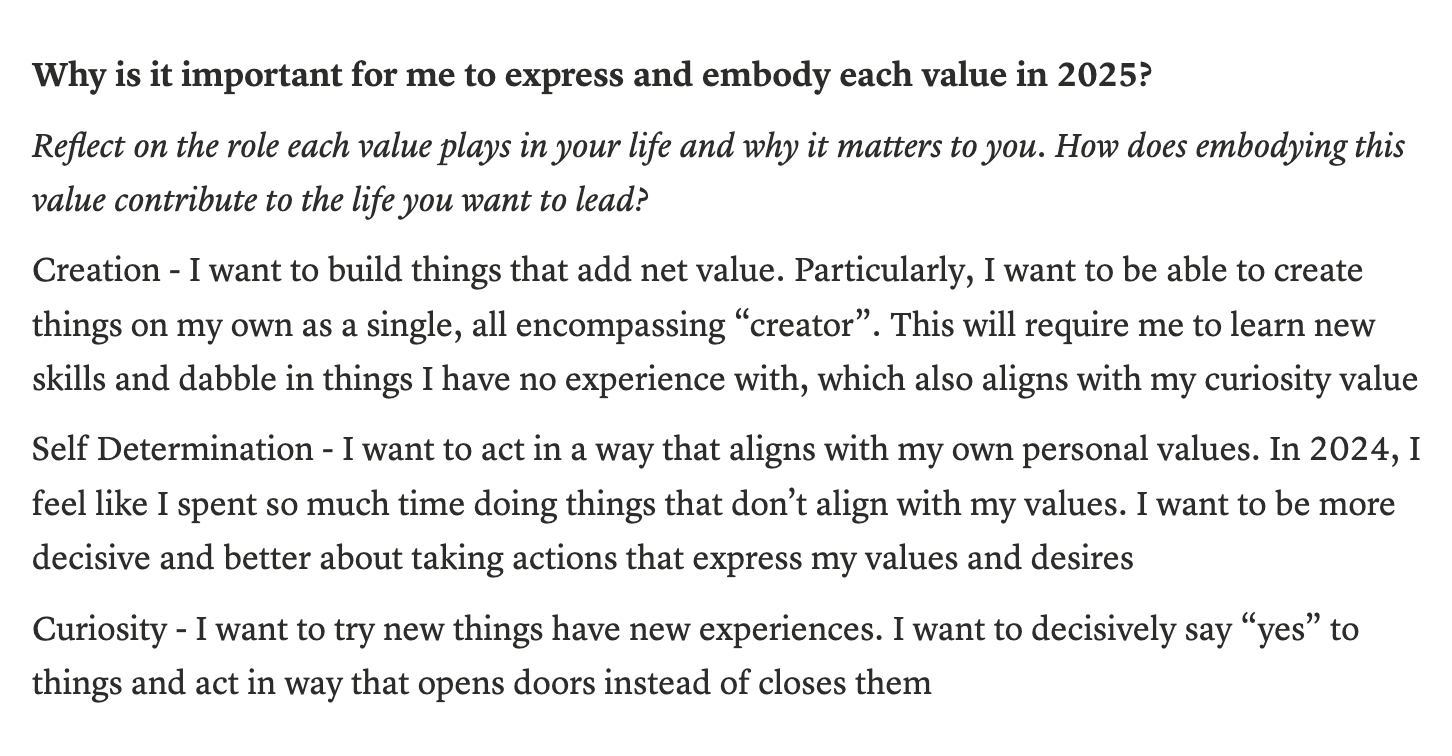
Seems familiar!
In taking this sabbatical, I feel that I can earnestly say that I have expressed the values of creation, self determination, and curiosity in 2025. I have created more (and on my own) in the last few months than I ever have before, thanks in large part to having access to so many new tools. I expressed self determination by choosing to take the sabbatical at all, which had the dual benefit of enabling me to do something that is consistent with my values as well as stop doing a bunch of things that weren’t. I followed my curiosity all over Japan and am now doing the same in Thailand.
I haven’t had a chance to do the 2025 reflection yet (will get to it right after I finish this post), but I expect that worthwhile work will be a central theme of 2026. I am grateful to have had the time during my sabbatical to further define what exactly worthwhile work means to me so that I can be intentional about finding something that meets this definition next year.
Wish me luck, and best of luck to you in finding whatever worthwhile work means to you in 2026.